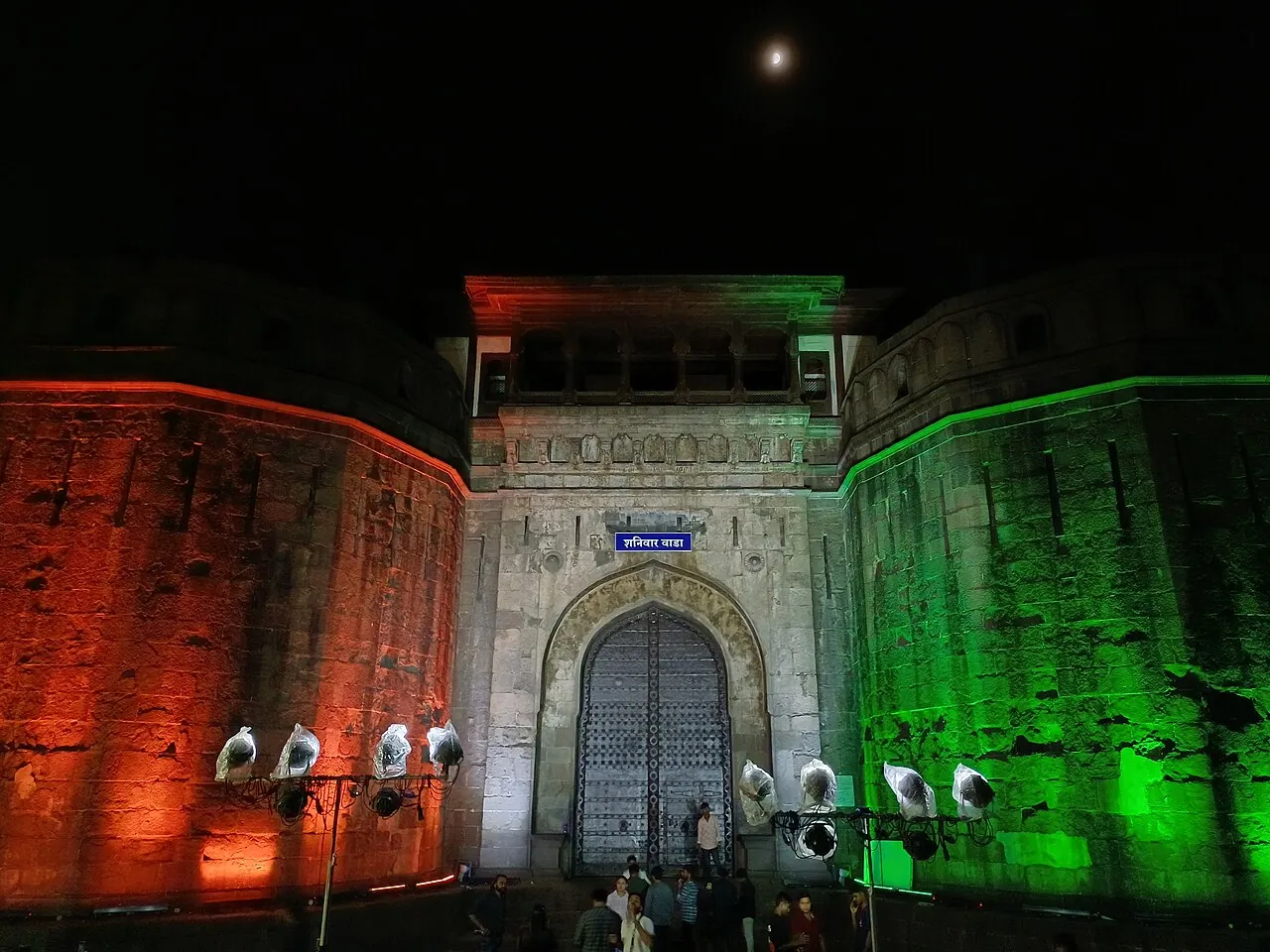
Shaniwar Wada — documentary photograph

Pune / Fortification

Shaniwar Wada

Shaniwar Wada was the fortified residence and political centre of the Peshwas in Pune.

View 1 photographs ↘Documentary photograph
DesiBoy101 · Original source · CC BY 4.0

YOUR EXPLORATION, AT A GLANCE

Difficulty Not Yet VerifiedMust Visit

The historical account and surviving feature descriptions offer a substantial heritage study visit.

View on map ⌖

District
Pune
Base / nearby village
Not yet verified
Nearby city
Pune
Source elevation
Not documented

Closest among 11 listed regional hubs by straight-line distance; not road distance. 0 km to the listed city.

THE STORY BEHIND THE STONE

Why Shaniwar Wada
matters.

Shaniwar Wada was the fortified residence and political centre of the Peshwas in Pune. Much of the palace complex was destroyed by fire in 1828. Its gates, enclosure and foundations still mark the scale of the former seat of power.

Rulers & historical periods +

Maratha, British / East India Company

Recorded possession intervals may omit changes of control. Exact uninterrupted durations are not assumed from a ruler’s reign.

A PLACE WITHIN THE LARGER STORY

Turning points.
1732
Shaniwar Wada — documentary photographExplore Shaniwar Wada ↗

Expansion across India

Shaniwar Wada and Pune’s political role

Shaniwar Wada is a historical fortification in the city of Pune, India. Built in 1732, it was the seat of the Peshwas of the Maratha Confederacy until 1818. The fort itself was largely destroyed in 1828 by an unexplained fire, but the surviving structures are now maintained as a tourist site. The Shaniwar Wada was normally the seven-story capital building of the Peshwas of the Maratha Empire. It was supposed to be made entirely of stone. However, after the completion of the base floor or the first story, the people of Satara complained to the Chhatrapati Shahu saying that a stone monument can be sanctioned and built only by the Chhatrapati himself and not the Peshwas. Following this, an official letter was written to the Peshwas stating that the remaining building had to be made of brick and not stone. By 1758, at least a thousand people lived in the fort. In 1773, Narayanrao, who was the tenth and ruling Peshwa then, was murdered by guards on orders of his uncle Raghunathrao and aunt Anandibai. A popular legend has it that Narayanrao's ghost still calls for help on full moon nights.
Read full story

Adapted source account from the linked Wikipedia article (CC BY-SA 4.0). Parenthetical material and citation markers have been omitted.

Shaniwar Wada is a historical fortification in the city of Pune, India. Built in 1732, it was the seat of the Peshwas of the Maratha Confederacy until 1818. The fort itself was largely destroyed in 1828 by an unexplained fire, but the surviving structures are now maintained as a tourist site. The Shaniwar Wada was normally the seven-story capital building of the Peshwas of the Maratha Empire. It was supposed to be made entirely of stone. However, after the completion of the base floor or the first story, the people of Satara complained to the Chhatrapati Shahu saying that a stone monument can be sanctioned and built only by the Chhatrapati himself and not the Peshwas. Following this, an official letter was written to the Peshwas stating that the remaining building had to be made of brick and not stone. By 1758, at least a thousand people lived in the fort.

In 1773, Narayanrao, who was the tenth and ruling Peshwa then, was murdered by guards on orders of his uncle Raghunathrao and aunt Anandibai. A popular legend has it that Narayanrao's ghost still calls for help on full moon nights. Various people, working around the area, have allegedly reported the cries of "Kaka mala vachava" by Narayanrao Peshwa after his death. The book, Assassination of the Peshwa, written in English and Marathi, covers this incident in detail. In June 1818, the Peshwa, Bajirao II, abdicated his Gaadi to Sir John Malcolm of the British East India Company and went into political exile at Bithoor, near Kanpur in present-day Uttar Pradesh, India. On 27 February 1828, a great fire started inside the palace complex. The conflagration raged for seven days. Only the heavy granite ramparts, strong teak gateways and deep foundations and ruins of the buildings within the fort survived. According to Haricharitramrutsagar, a biographical text of Bhagwan Swaminarayan, he had visited Shaniwarwada on the insistence of Bajirao II in 1799.
Consult the original article and its cited historical works for source evidence and differing interpretations. The timeline date identifies the event or beginning of the period; this account may cover a longer span.

Shaniwar Wada ↗

Sources: Shaniwar Wada — historical account and references, Contributor history and attribution, CC BY-SA 4.0 — adapted source extract

READING THE REMAINS

Architecture &
fort features.

Explore features described in the historical source. Their surviving condition and access can vary.

01Bastions +

Bastions is recorded in the linked account of Shaniwar Wada. Explore the historical sources ↗

02Gateways +

Gateways is recorded in the linked account of Shaniwar Wada. Explore the historical sources ↗

03Palace remains +

Palace remains is recorded in the linked account of Shaniwar Wada. Explore the historical sources ↗

04Ramparts +

Ramparts is recorded in the linked account of Shaniwar Wada. Explore the historical sources ↗

Feature inventory only. A surveyed top-down plan is not yet available in this guide.

KNOW THE APPROACH

Plan your
exploration.

Difficulty Not Yet Verified
  • Reliable route evidence is insufficient for a numerical rating.

Detailed routes are not verified. Consult the source guide and confirm access locally.

Assessment & safety notes +

Not verified. Insufficient evidence.

Check current local access and weather before travelling. Carry water, use established routes, and leave stonework undisturbed. A map pin identifies the monument, not a safe trailhead or landing point.

Source review: 2026-11-15. Stars describe route difficulty; recommendations are separate editorial judgements. No community review counts are displayed.

KEEP THE JOURNEY GOING

More of Pune.

All forts ↗
Research sources & image credits +
  1. Shaniwar Wada — history, geographical facts and references ↗

Source review: 2026-11-15. Coordinates: Source-referenced.

Research approach and credits ↗