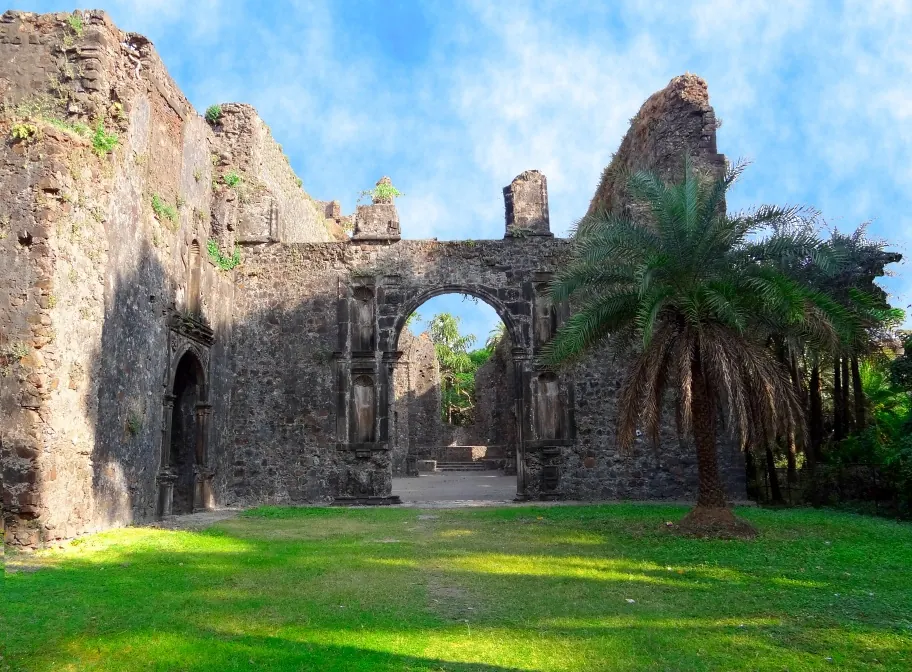
Vasai Fort — documentary photograph

Palghar / Coastal fort

Vasai Fort

The Portuguese developed Vasai, or Bassein, as a major fortified settlement on the north Konkan coast.

View 9 photographs ↘Documentary photograph
Gladson Machado · Original source · CC BY-SA 3.0

YOUR EXPLORATION, AT A GLANCE

EasyRecommended

The source describes church remains, ramparts, offering a useful introduction to this fort’s architecture.

View on map ⌖

District
Palghar
Base / nearby village
Not yet verified
Nearby city
Mumbai
Source elevation
Not documented

Closest among 11 listed regional hubs by straight-line distance; not road distance. 29 km to the listed city.

THE STORY BEHIND THE STONE

Why Vasai Fort
matters.

The Portuguese developed Vasai, or Bassein, as a major fortified settlement on the north Konkan coast. Maratha forces under Chimaji Appa captured it in 1739. Surviving churches, walls and gateways reflect the scale of the former town.

Also known as Bassein

Rulers & historical periods +

Portuguese

Yadava dynasty (-1432) Gujarat Sultanate (1432-1533) Portugal (1534-1739) Maratha Empire (1739-1818) East India Company (1818-1857) British Raj (1857-1947) India (1947-) Archaeological Survey Of India (source infobox; intervals are approximate and may omit changes of possession)

Recorded possession intervals may omit changes of control. Exact uninterrupted durations are not assumed from a ruler’s reign.

A PLACE WITHIN THE LARGER STORY

Turning points.
1739
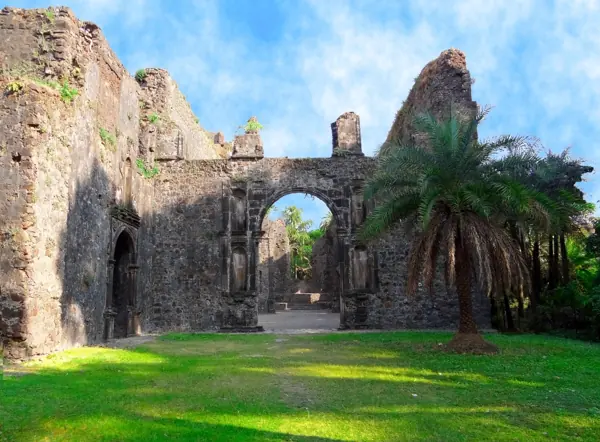
Vasai Fort — documentary photographExplore Vasai Fort ↗

Expansion across India

The capture of Vasai

The Battle of Vasai or the Battle of Bassein was fought between the Maratha Empire and the Portuguese rulers of Vasai, a town near Mumbai in the Konkan region of the present-day state of Maharashtra, India. The Marathas were led by Chimaji Appa, a brother of Peshwa Baji Rao I. By 1736, the Portuguese had been at work for four years constructing the fortress of Thana, and aside from the long delays, the workers were unpaid and unfed. Bhavangad Fort was built by Shrimant Chimaji Appa Peshave to capture the Fort Bassein by Maratha Army, and most of the secret activities were done at Bhavangad fort. After the war of 1737-39, Chimaji Appa and his Maratha soldiers took the church bells from Vasai as memorabilia and installed them in various Hindu temples of Maharashtra; some of the bells they installed in the Khandoba Temple of Jejuri and the Tulja Bhavani Temple of Osmanabad. These church bells are still present in these temples. The garrison of Baçaim, thanks to the reinforcements received from Goa, was of about 1,200 soldiers, among Portuguese and Indian auxiliaries. The siege of Baçaim began on 17 February 1739. All the Portuguese outposts around the major fort at Baçaim had been taken. Their supply routes from the north and south had been blocked, and with the English manning the seas, even that route was unreliable.
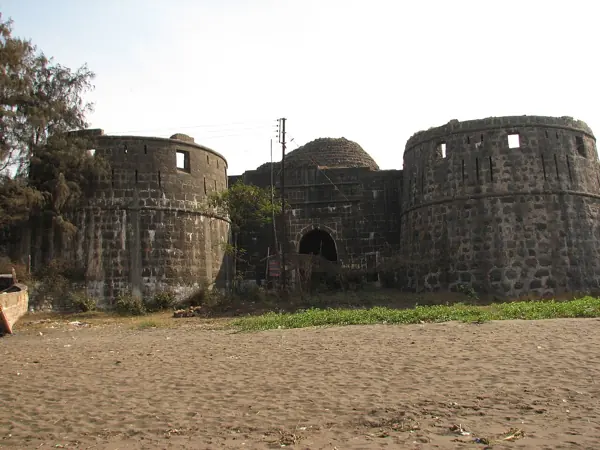
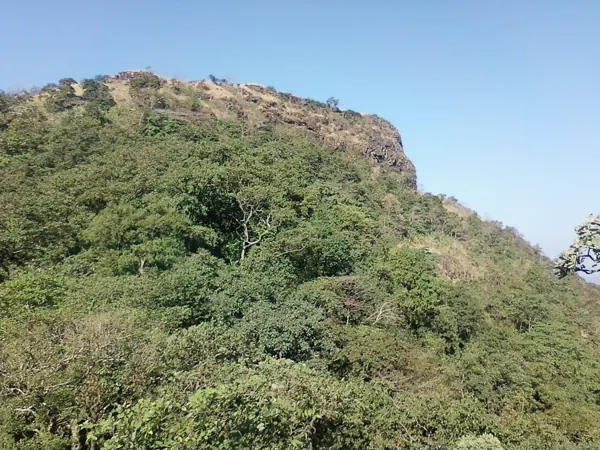
Read full story

Adapted source account from the linked Wikipedia article (CC BY-SA 4.0). Parenthetical material and citation markers have been omitted.

The Battle of Vasai or the Battle of Bassein was fought between the Maratha Empire and the Portuguese rulers of Vasai, a town near Mumbai in the Konkan region of the present-day state of Maharashtra, India. The Marathas were led by Chimaji Appa, a brother of Peshwa Baji Rao I. By 1736, the Portuguese had been at work for four years constructing the fortress of Thana, and aside from the long delays, the workers were unpaid and unfed. Bhavangad Fort was built by Shrimant Chimaji Appa Peshave to capture the Fort Bassein by Maratha Army, and most of the secret activities were done at Bhavangad fort. After the war of 1737-39, Chimaji Appa and his Maratha soldiers took the church bells from Vasai as memorabilia and installed them in various Hindu temples of Maharashtra; some of the bells they installed in the Khandoba Temple of Jejuri and the Tulja Bhavani Temple of Osmanabad. These church bells are still present in these temples. The garrison of Baçaim, thanks to the reinforcements received from Goa, was of about 1,200 soldiers, among Portuguese and Indian auxiliaries. The siege of Baçaim began on 17 February 1739. All the Portuguese outposts around the major fort at Baçaim had been taken. Their supply routes from the north and south had been blocked, and with the English manning the seas, even that route was unreliable. Chimaji Appa arrived at Bhadrapur near Baçaim in February 1739. According to a Portuguese account, his forces numbered 40,000 infantry, 25,000 cavalry, and around 4,000 soldiers trained in laying mines. Furthermore, he had 5,000 camels and 50 elephants. More joined from Salsette in the following days, increasing the total Maratha troops amassed to take Baçaim to close to 100,000.
The Portuguese, alarmed at this threat, decided to vacate Bandra, Versova, and Dongri so as to better defend Baçaim. As per the orders of the Portuguese Viceroy, the Count of Sandomil, only Baçaim, Damão, Diu, and Karanja were to be defended. These were duly fortified. In March 1739, Manaji Angre attacked Uran and captured it from the Portuguese. This was followed by easy Maratha victories at Bandra, Versova and Dharavi, which the Portuguese garrison had vacated. Manaji Angre joined Chimaji Appa at Vasai after this. Thus, by April 1739, the noose around Baçaim had further tightened. Within the fort, the towers of São Sebastião and Nossa Senhora dos Remédios faced the Marathas at Bhadrapur. The barracks and everything else were inside, with the main gate facing the Vasai Creek. Appa began the siege on 1 May 1739 by laying 10 mines next to the walls near the tower of Remédios. Maratha soldiers charged into the breach caused by exploding four of them. Almost immediately, they came under fire from Portuguese guns and muskets. Appa, Malhar Rao Holkar, Ranoji Shinde and Manaji Angre goaded their contingents to scale the walls throughout the day. Next day, on 2 May, the towers of São Sebastião and Remédios were repeatedly attacked. More mines were set off during the day, causing large breaches in the walls between the two towers.

Consult the original article and its cited historical works for source evidence and differing interpretations. The timeline date identifies the event or beginning of the period; this account may cover a longer span.

Vasai Fort ↗

Sources: Battle of Vasai — historical account and references, Contributor history and attribution, CC BY-SA 4.0 — adapted source extract

READING THE REMAINS

Architecture &
fort features.

Explore features described in the historical source. Their surviving condition and access can vary.

01Church remains +

Church remains is recorded in the linked account of Vasai Fort. Explore the historical sources ↗

02Ramparts +

Ramparts is recorded in the linked account of Vasai Fort. Explore the historical sources ↗

Feature inventory only. A surveyed top-down plan is not yet available in this guide.

KNOW THE APPROACH

Plan your
exploration.

Easy
  • The source assigns this grade but does not provide enough route detail to explain individual obstacles.

One should go to Vasai. Buses ply regularly from New Vasai to Old Vasai. Buses from New Vasai directly to the fort are also available.

Assessment & safety notes +

Approach described in the linked field guide. Provisional — source guide, current conditions unverified.

Check current local access and weather before travelling. Carry water, use established routes, and leave stonework undisturbed. A map pin identifies the monument, not a safe trailhead or landing point.

Source review: 2026-11-15. Stars describe route difficulty; recommendations are separate editorial judgements. No community review counts are displayed.

KEEP THE JOURNEY GOING

More of Palghar.

All forts ↗
Research sources & image credits +
  1. Vasai Fort — history, geographical facts and references ↗
  2. Trekshitiz — field guide and source trek information ↗

Source review: 2026-11-15. Coordinates: Source-referenced.

Research approach and credits ↗