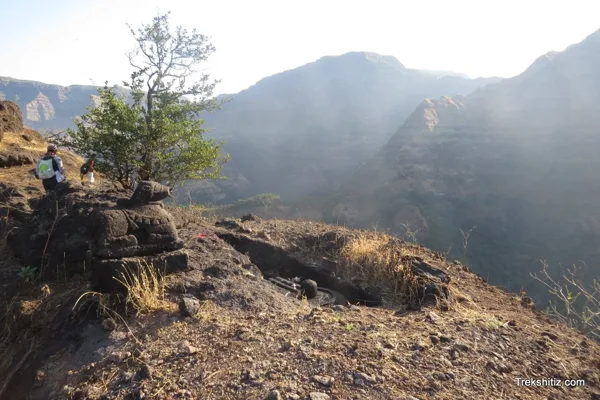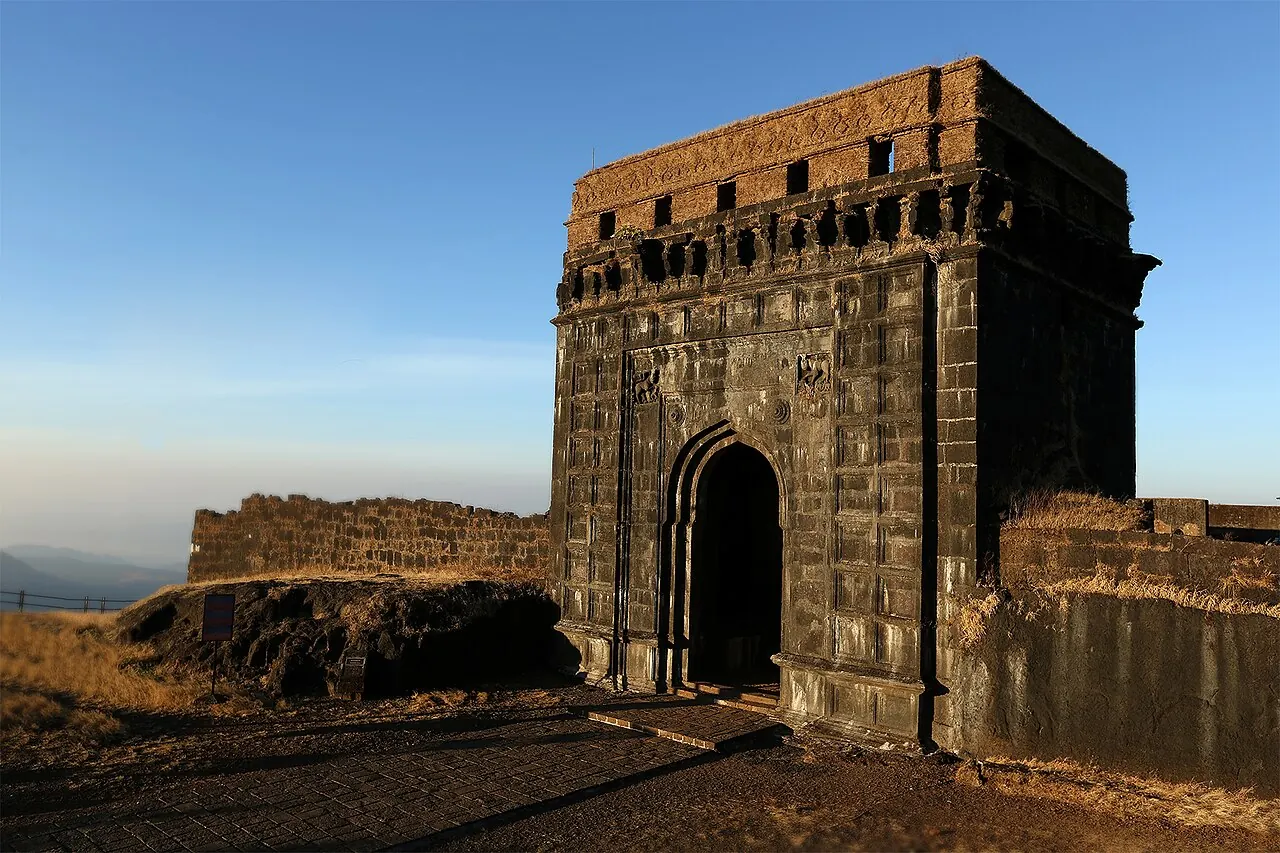
Raigad — documentary photograph

Raigad / Hill fort

Raigad

रायगड

Raigad became the capital of Chhatrapati Shivaji Maharaj’s kingdom.

View 9 photographs ↘Documentary photograph
Nilamgandhre · Original source · CC BY-SA 4.0

YOUR EXPLORATION, AT A GLANCE

EasyMost Recommended

Its documented role in the Maratha fort network gives it exceptional educational and historical value.

View on map ⌖

District
Raigad
Base / nearby village
Pachad
Nearby city
Pune
Source elevation
820 metres (2,700 ft) ASL

Closest among 11 listed regional hubs by straight-line distance; not road distance. 54 km to the listed city.

THE STORY BEHIND THE STONE

Why Raigad
matters.

Raigad became the capital of Chhatrapati Shivaji Maharaj’s kingdom. His coronation took place here in 1674. The remains of the royal precinct, gateways and water systems make the fort a key place for understanding the government and ceremony of Swarajya.

Also known as Rairi

Rulers & historical periods +

Individual ruling powers have not been established in this entry.

Shirke family (before 1656) Maratha Empire (1656–1689; 1739–1818) Mughal Empire (1689–1739) East India Company (1818–1858) British Raj (1858-1947) Government of India (after 1947) (source infobox; intervals are approximate and may omit changes of possession)

Recorded possession intervals may omit changes of control. Exact uninterrupted durations are not assumed from a ruler’s reign.

A PLACE WITHIN THE LARGER STORY

Turning points.
6 June 1674
Raigad — documentary photographExplore Raigad ↗

Kingship and administration

Raigad and the coronation of Chhatrapati Shivaji Maharaj

Raigad developed from the earlier stronghold of Rairi. Chhatrapati Shivaji Maharaj acquired it in 1656. It became a carefully developed royal and administrative centre. His coronation took place here on 6 June 1674. The ceremony formally expressed sovereign kingship. Raigad brought court, administration and defence together. The capital connected the Sahyadri uplands with the Konkan. Chhatrapati Shivaji Maharaj died at the fort in 1680. Chhatrapati Sambhaji Maharaj continued the royal association with Raigad. The site remains central to the memory of Swarajya and public service.

Read full story

Raigad’s importance grew from the conversion of an existing stronghold into a royal capital. Formerly known as Rairi, it entered Chhatrapati Shivaji Maharaj’s possession in 1656 and was developed over the following years. The move from the earlier headquarters at Rajgad was part of the growth of the Maratha state. A capital needed secure approaches, space for a court and administration, and practical arrangements for the people and supplies required to sustain it.

On 6 June 1674, Chhatrapati Shivaji Maharaj was crowned at Raigad. The coronation gave formal expression to sovereignty after decades of political organisation and military campaigning. It was not the beginning of every aspect of Swarajya: much of the work of building authority, securing territory and organising government had already taken place. The ceremony marked a new constitutional and ceremonial standing for that established achievement.

The fort’s surviving royal and public spaces help visitors move beyond the image of a solitary mountain fortress. Court, market, religious and residential areas belonged to a functioning capital. The landscape also linked the defended summit to settlements and routes below. These relationships explain why the history of Raigad includes administration and everyday labour alongside the most famous royal events.

Chhatrapati Shivaji Maharaj died here in 1680, and his memorial remains one of the fort’s most significant places. Raigad continued to be associated with Chhatrapati Sambhaji Maharaj and the subsequent struggle for the state. Its legacy therefore includes both the founding generation and those who carried responsibility afterwards. Visiting with respect means attending to these connected histories, preserving the fabric and treating memorial and sacred areas with care.

Raigad ↗Rajgad ↗

Sources: Press Information Bureau — Raigad and the coronation, Maharashtra Ahead — Raigad history, Raigad Fort — source article and references

1680
Raigad — documentary photographExplore Raigad ↗

Kingship and administration

Death of Chhatrapati Shivaji Maharaj

In late March 1680, Shivaji fell ill with fever and dysentery, dying around 3–5 April 1680 at the age of 50, at Raigad Fort, on the eve of Hanuman Jayanti. The cause of Shivaji's death is disputed. British records state Shivaji died of bloody flux, after being sick for 12 days. In a contemporary work in Portuguese, in the Biblioteca Nacional de Lisboa, the recorded cause of death of Shivaji is anthrax. However, Krishnaji Anant Sabhasad, author of the Sabhasad Bakhar, a biography of Shivaji has mentioned fever as the cause of death. Putalabai, the childless eldest of the surviving wives of Shivaji committed sati by jumping into his funeral pyre. Another surviving spouse, Sakwarbai, was not allowed to follow suit because she had a young daughter. There were also allegations, though doubted by later scholars, that his second wife Soyarabai had poisoned him in order to put her 10-year-old son Rajaram on the throne. After Shivaji's death, Soyarabai made plans, with various ministers, to crown her son Rajaram rather than her stepson Sambhaji. On 21 April 1680, ten-year-old Rajaram was installed on the throne.

Read full story

Adapted source account from the linked Wikipedia article (CC BY-SA 4.0). Parenthetical material and citation markers have been omitted.

In late March 1680, Shivaji fell ill with fever and dysentery, dying around 3–5 April 1680 at the age of 50, at Raigad Fort, on the eve of Hanuman Jayanti. The cause of Shivaji's death is disputed. British records state Shivaji died of bloody flux, after being sick for 12 days. In a contemporary work in Portuguese, in the Biblioteca Nacional de Lisboa, the recorded cause of death of Shivaji is anthrax. However, Krishnaji Anant Sabhasad, author of the Sabhasad Bakhar, a biography of Shivaji has mentioned fever as the cause of death. Putalabai, the childless eldest of the surviving wives of Shivaji committed sati by jumping into his funeral pyre.

Another surviving spouse, Sakwarbai, was not allowed to follow suit because she had a young daughter. There were also allegations, though doubted by later scholars, that his second wife Soyarabai had poisoned him in order to put her 10-year-old son Rajaram on the throne. After Shivaji's death, Soyarabai made plans, with various ministers, to crown her son Rajaram rather than her stepson Sambhaji. On 21 April 1680, ten-year-old Rajaram was installed on the throne. However, Sambhaji took possession of Raigad Fort after killing the commander, and on 18 June acquired control of Raigad, and formally ascended the throne on 20 July. Rajaram, his mother Soyarabai and wife Janki Bai were imprisoned, and Soyrabai was executed on charges of conspiracy that October.

Consult the original article and its cited historical works for source evidence and differing interpretations. The timeline date identifies the event or beginning of the period; this account may cover a longer span.

Raigad ↗

Sources: Shivaji — historical account and references, Contributor history and attribution, CC BY-SA 4.0 — adapted source extract

1681–1689
Raigad — documentary photographExplore Raigad ↗

Resistance and endurance

Chhatrapati Sambhaji Maharaj: kingship and resistance

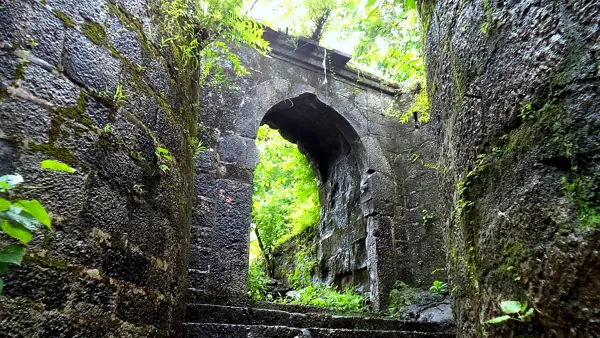
Chhatrapati Sambhaji Maharaj was born at Purandar in 1657. He succeeded Chhatrapati Shivaji Maharaj after the crisis of 1680. His formal coronation at Raigad took place in January 1681. He carried responsibility for the Maratha state during intense warfare. Aurangzeb’s arrival in the Deccan brought sustained Mughal pressure. The kingdom also faced challenges along its western coast. Forts, commanders and supply systems sustained resistance across several fronts. His reign cannot be understood through battles alone. He was captured and executed in 1689. His life remains an enduring part of Maharashtra’s memory of courage and duty.

Read full story

Chhatrapati Sambhaji Maharaj inherited a substantial but contested state. Born at Purandar in 1657, he had grown up within the political world created by Chhatrapati Shivaji Maharaj. After his father’s death in 1680, a succession struggle preceded his establishment as ruler. The formal coronation at Raigad took place in January 1681. Some accounts give different day dates, so the month and year are used here rather than presenting that disagreement as settled.

His reign coincided with a particularly demanding phase of the Mughal–Maratha conflict. Aurangzeb brought the imperial court and army into the Deccan, making warfare prolonged and geographically extensive. The Maratha state also dealt with the Siddis and Portuguese on the coast. Decisions about armies, supplies, diplomacy and the protection of territory were therefore connected across several fronts. A ruler could not be physically present at every fort that resisted an attack.

The forts mattered as places for garrisons, stores, administration and communication. Their survival depended on commanders and communities as well as royal direction. Remembering Chhatrapati Sambhaji Maharaj’s contribution should include that work of maintaining a state under pressure, rather than relying on unsupported claims that no fort was ever lost or that every campaign ended in victory. Historical respect is compatible with recognising the difficulty and complexity of the circumstances.

He was captured at Sangameshwar in 1689 and executed by order of Aurangzeb. The Maratha struggle continued under Chhatrapati Rajaram Maharaj and later under Maharani Tarabai’s leadership. His death was therefore a profound rupture, but not the end of Maratha resistance. Raigad, Purandar and Panhala provide different points of entry into his life: royal capital, birthplace and a stronghold associated with the succession. Together they give his memory a fuller historical setting.

Raigad ↗Purandar fort ↗Panhala Fort ↗

Sources: Kolhapur Gazetteer — succession and January 1681 coronation, University of Mumbai — History of Medieval India, Sambhaji — biographical account and references, Sangli Gazetteer — capture and execution in 1689

READING THE REMAINS

Architecture &
fort features.

Explore features described in the historical source. Their surviving condition and access can vary.

01Bastions +

Bastions is recorded in the linked account of Raigad. Explore the historical sources ↗

02Temple remains +

Temple remains is recorded in the linked account of Raigad. Explore the historical sources ↗

03Gateways +

Gateways is recorded in the linked account of Raigad. Explore the historical sources ↗

04Granaries +

Granaries is recorded in the linked account of Raigad. Explore the historical sources ↗

05Palace remains +

Palace remains is recorded in the linked account of Raigad. Explore the historical sources ↗

Feature inventory only. A surveyed top-down plan is not yet available in this guide.

KNOW THE APPROACH

Plan your
exploration.

Easy
  • The source assigns this grade but does not provide enough route detail to explain individual obstacles.

Raigad being situated 30km to the north of Mahad, ST buses ply regularly from Mahad. There are buses from Mumbai Central and Pune which ply to Mahad or Raigad via Mahad. We can ascend Raigad either by walk or by ropeway. If we want to ascend the fort by walk,…

Assessment & safety notes +

Approach described in the linked field guide. Provisional — source guide, current conditions unverified.

Check current local access and weather before travelling. Carry water, use established routes, and leave stonework undisturbed. A map pin identifies the monument, not a safe trailhead or landing point.

Source review: 2026-11-15. Stars describe route difficulty; recommendations are separate editorial judgements. No community review counts are displayed.

KEEP THE JOURNEY GOING

More of Raigad.

All forts ↗

MAHARASHTRA TOURISM · BROCHURE GUIDE

Raigad: heritage & nearby places

Raigad became Chhatrapati Shivaji Maharaj’s capital and the setting of his 1674 coronation. The Maha Darwaja, royal court, Nagarkhana and Hirakani Bastion reveal the ceremonial and defensive roles of the capital.

Landmarks to look for

  • Maha Darwaja
  • Royal durbar and throne replica
  • Nagarkhana Darwaja
  • Hirakani Bastion
  • Takmak Tok
  • Jagadishwar Temple
  • Gangasagar Lake
  • Raj Bhawan

Places in the wider area

  • Raigad Museum

Brochure activity ideas: Museum visits and trekking; the brochure also describes ropeway access.

Travel distances from the brochure

Distances are reproduced as brochure figures, not current measured routes. The brochure is undated. Confirm routes and access locally.

By air
Mumbai 170 km; Pune 130 km
By rail
Mangaon 30 km
By road
Pune 130 km; Mumbai 150 km; Mahad 24 km

Source clarification: Confirm ropeway operations and any camping permissions before visiting.

Adapted from Maharashtra Tourism, Guardians of History — The formidable forts of Maharashtra, PDF pages 10. Read the original PDF ↗ · Explore all brochure forts ↗

Research sources & image credits +
  1. Raigad Fort — history, geographical facts and references ↗
  2. Trekshitiz — field guide and source trek information ↗

Source review: 2026-11-15. Coordinates: Source-referenced.

Research approach and credits ↗